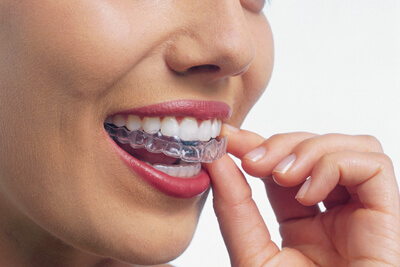
Did you know many people who want straight teeth never go through with treatment because they just don’t like the way braces look? Invisalign is the virtually invisible way to straighten your teeth without braces, using a series of clear, removable aligners to straighten your teeth without metal wires or brackets. Patients wear each set of clear aligners for about two weeks, removing them only to eat, drink, brush, and floss. As you replace each aligner with the next in the series, your teeth will move – little by little, week by week – until they have straightened to the final position Dr. Sharma has prescribed. Visits to Aura Orthodontics are about once every six weeks to ensure that your treatment is progressing as planned.
Total treatment time averages 9-15 months and the average number of aligners worn during treatment is between 18 and 30, but both will vary from case to case.
Although clear aligners are appropriate for many orthodontic problems, they are still biomechanically inferior to conventional braces in many situations. Because it is more difficult for plastic shells to create some of the forces required for complex tooth movements like turning round teeth, making teeth longer, and paralleling roots in extraction cases, most orthodontists still prefer to use brackets and wires for moderate to severe cases.
Here’s some frequently asked questions:
How does Invisalign work?
We will utilize 3D computer imaging technology to demonstrate the complete treatment plan from the initial position to the final desired position. This imaging technology is then used to design an individualized series of custom-made aligners. Patients wear the aligner for about two weeks while their teeth move incrementally. After two weeks, the current aligner is replaced with the next one until the final position is achieved.
What do aligners look like?
Aligners are clear and nearly invisible. Invisalign aligners are custom-made to fit and move your teeth.
Will the treatment be painful?
Each time you change to a new aligner, there may be some temporary discomfort while your teeth adjust to their new position. This is completely normal, and is a good sign that the treatment is working.
Will wearing Invisalign aligners affect my speech?
Some people are affected more than others, but most adjust in a short period of time to the feeling of the aligners and do not have permanent changes in their speech.
How often will I have to wear my aligners?
Invisalign only works while you’re wearing the aligners. It’s recommended that you wear your aligners full-time, day and night, except to eat, brush, and floss your teeth.
How much does Invisalign cost?
Cost is always a concern, and Dr. Sharma can determine the price of treatment. It is typically in the same range as ordinary metal braces, depending on the requirements of your specific case. Rest assured that during a consultation with Dr. Sharma, financial figures are discussed in depth. At Aura Orthodontics, we work together with our patients to ensure payment options are very flexible and affordable for all our patients. We also offer interest free financing and accept cash, cheque, Visa, MasterCard, American Express and Debit.
Invisalign versus Fixed Braces – The Pros
- Aesthetic Appeal – With Invisalign, you wear removable and invisible plastic trays as opposed to traditional fixed or metal braces, which are cemented onto your teeth. So, cosmetically, Invisalign offer a clear advantage: many individuals, especially adults, who are self-conscious about getting orthodontic treatment, appreciate this.
- Easier Oral Hygiene – Since Invisalign trays are removable, it’s much easier to brush and floss properly. With fixed braces, food often gets trapped around brackets and wires, making cleaning more challenging.
- Improved Gum Health – Because it’s easier to maintain good oral hygiene with Invisalign, overall gingival (gum) health tends to be better. Healthy gums are pink, firm, and don’t bleed easily. Gingivitis—characterised by red, swollen, and bleeding gums—occurs more frequently in patients who struggle with cleaning around fixed braces.
- Fewer Food Restrictions – With Invisalign, you can generally eat whatever you like, as the trays are removed during meals. With fixed braces, however, it’s best to avoid sticky, hard, or crunchy foods that can damage brackets.
- Lower Risk of Decalcification – Fixed braces can sometimes lead to decalcification (weakened enamel) and decay around the brackets. This happens because food particles are difficult to remove from around the bonded areas. Invisalign reduces this risk since there are no brackets attached to the teeth.
- More Frequent Adjustments – With Invisalign, patients switch to a new aligner tray approximately every two weeks. In contrast, fixed braces typically require wire adjustments every six weeks. This difference can significantly impact the progression and experience of treatment.
Invisalign versus Fixed Braces – The Cons
- Requires Strong Commitment –Invisalign trays must be worn 20–22 hours per day to be effective. This requires discipline and patient compliance.
- Cleaning Responsibility – The trays need to be removed before eating and cleaned regularly. Patients must be diligent about maintaining both their trays and their teeth.
- Risk of Losing Trays – Because Invisalign aligners are removable, they can be misplaced. Losing a tray may delay treatment and could require new impressions and replacement trays.
- Limitations in Certain Movements – Some complex tooth movements are more difficult to achieve with Invisalign. For example, correcting teeth that are significantly higher in the arch can sometimes be more effectively treated with traditional braces.
Making the Right Choice
When deciding between Invisalign and fixed braces, it’s important to consider your specific orthodontic needs. Ask yourself:
-
Can Invisalign achieve my desired results?
-
Am I comfortable wearing wire braces?
-
Is treatment time important to me?
Overall, Invisalign offers many advantages, including comfort, aesthetics, convenience, reduced risk of decay, and easier oral hygiene. However, its success depends heavily on patient compliance.
Braces and Invisalign both have their place in orthodontic treatment. What matters most is choosing the option that will provide you with a healthy, functional bite and a beautiful smile.
At Aura Orthodontics, Dr. Sharma will work with you to determine the best treatment plan based on your individual needs. If you have questions or would like to schedule a complimentary consultation, please contact our office.